Table of Content
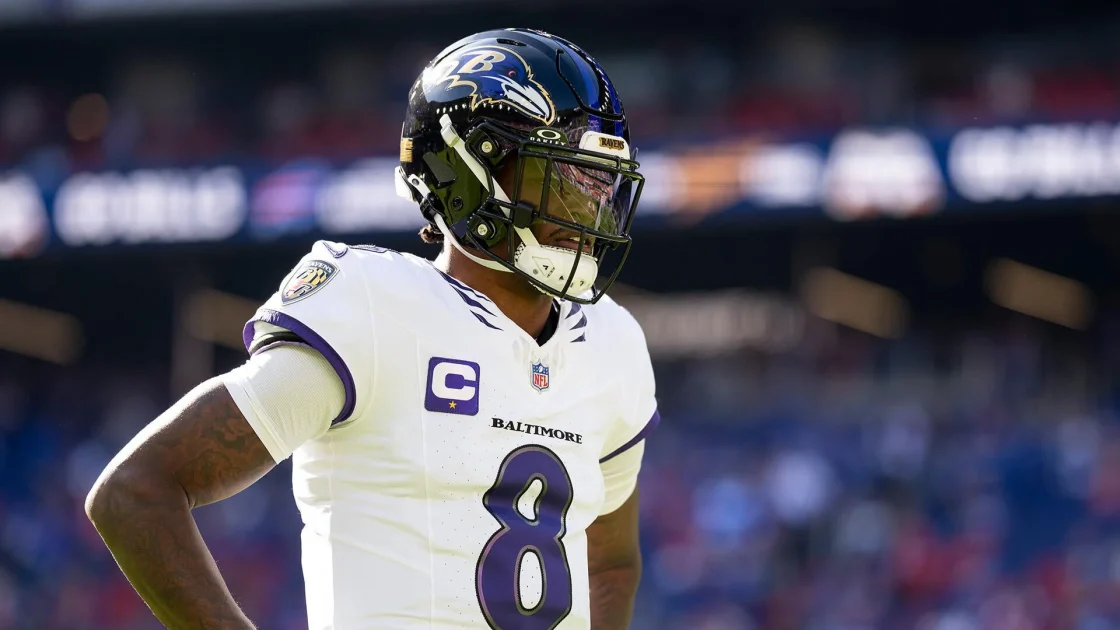
Baltimore Ravens quarterback Lamar Jackson faces an uncertain future after sustaining a right thumb injury that requires surgery, placing him on injured reserve indefinitely. The injury occurred on his first offensive play back from a three-game absence due to a high ankle sprain during Baltimore’s 36-10 loss to the Buffalo Bills, when his hand struck edge rusher Greg Rousseau on a pass follow-through.
The potential season-ending setback has intensified scrutiny around Jackson’s long-term standing with the franchise. In an analysis published by CBS Sports, former sports agent Joel Corry outlined the complex financial and contractual options confronting both Jackson and the Ravens as his deal approaches its final years.
Financial Breakdown and Salary Cap Pressure
Jackson is currently in the fourth year of a five-year, $260 million contract that averaged $52 million annually when signed. For the 2027 season, he is scheduled to earn an unsecured $52 million, composed of a $51.25 million base salary and a $750,000 workout bonus. However, his salary cap charge for 2027 stands at an extraordinary $84.34 million.
That cap figure represents the second-highest scheduled hit in the NFL for 2027, trailing only Kansas City Chiefs quarterback Patrick Mahomes’ $90.35 million charge. The figure presents a major obstacle for Baltimore, which already holds an NFL-high $366.74 million in 2027 cap commitments across 45 players, against an expected league salary cap between $322.5 million and $327.5 million.
Compounding the situation for Baltimore are specific contractual stipulations. Jackson’s agreement includes a full no-trade clause alongside a clause that forbids the Ravens from using a franchise or transition tag on him when the contract expires after the 2027 season.
Contract Control and Availability Concerns
According to reports cited by CBS Sports, Ravens owner Steve Bisciotti sought to negotiate a contract extension prior to March 2026, but Jackson—who acts as his own agent—did not move forward with a deal. Baltimore instead restructured his contract to generate $39.96 million in 2026 cap relief by adding a voiding 2030 contract year for bonus proration.
Jackson retains substantial leverage in future discussions due to his tag protection and high cap number, despite recent durability issues. Over the 2025 and 2026 seasons, Jackson has dealt with ailments affecting his hamstring, ankle, toe, knee, back, and thumb, appearing in only 18 of a possible 34 regular-season games if he misses the remainder of the current campaign. By contrast, he missed just one game combined across 2023 and 2024.
Before his initial ankle injury in 2026, Jackson produced strong numbers under new offensive coordinator Declan Doyle. In four full games, he completed 70.8% of his passes for 967 yards, six touchdowns, and one interception for a 119.6 passer rating, while adding 144 rushing yards and a touchdown on 19 carries.
Corry noted that teams have historically extended elite quarterbacks despite major injuries, pointing to the Kansas City Chiefs restructuring Patrick Mahomes’ deal to an eight-year, $504.75 million package ($63.1 million average per year) following knee surgery and a down 2025 statistical season.
Trade Feasibility and Cap Dead Money
Because Jackson holds a no-trade clause, any potential deal would require his explicit approval. Executing a trade before the 2027 NFL Draft would trigger a massive $74.81 million dead money charge for Baltimore, providing only $9.53 million in immediate cap relief due to previous bonus conversions.
A post-June 1 trade in 2027 would allow the Ravens to divide that dead money into $32.34 million in 2027 and $42.47 million in 2028, creating $52 million in 2027 cap space. However, carrying an $84.34 million cap number until June would severely constrain Baltimore’s offseason roster construction, while any acquiring team would likely demand a deal much earlier to integrate Jackson into their system.
Should Jackson choose to seek a move, his no-trade clause could also limit Baltimore’s trade yield compared to past marquee quarterback blockbusters, such as those involving Deshaun Watson or Russell Wilson, if Jackson targets a specific destination like his hometown Miami Dolphins.
If no extension or trade materializes, Baltimore could face the choice of keeping Jackson at his record cap hit, performing another contract restructure that shifts substantial dead money into 2028, or releasing him with a post-June 1 designation in 2027 to clear his base salary, which would allow him to enter free agency without yielding compensatory draft picks for Baltimore.