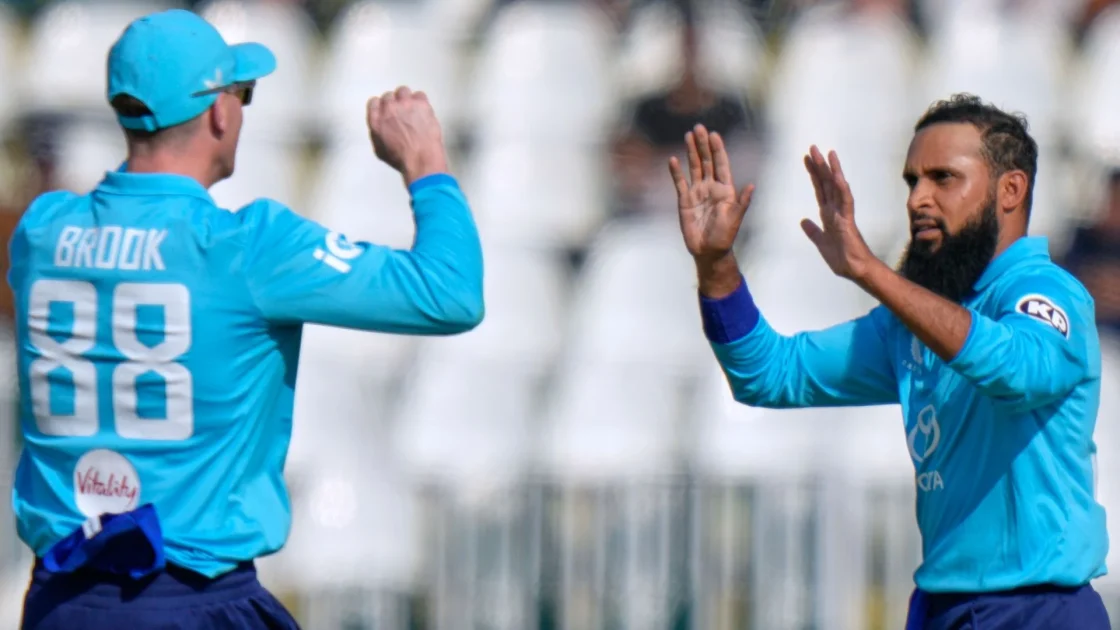
Adil Rashid has long been an essential pillar of England’s white-ball squad, helping rebuild the team after the 2015 World Cup and playing key roles in their 2019 ODI World Cup victory and 2022 T20 World Cup title. However, after being left out of the final three matches during last month’s one-day international tri-series against Pakistan and Sri Lanka, the 38-year-old leg-spinner faces rare uncertainty over his position in the side.
Tactical Omission and Recent Dip in Form
With 244 one-day international wickets to his name, Rashid sits second only to James Anderson (269) on England’s all-time list. Yet head coach Brendon McCullum explained that his recent omission was purely tactical, noting that Liam Dawson’s left-arm spin suited the subcontinental conditions in Pakistan better than Rashid’s leg-breaks. Spin statistics from the tri-series supported that choice, as southpaw bowlers like Pakistan’s Arafat Minhas (nine wickets at 23.22), Dawson (seven wickets at 21.42), and Sri Lanka’s Dunith Wellalage (four wickets at 48.25) topped the charts.
The decision to bench Rashid, coupled with his central contract ending prior to the late 2027 50-over World Cup, has highlighted a recent statistical decline. In 2026, Rashid has taken nine wickets in seven ODI appearances at an average of 36.22 and a strike rate of 37.50. That contrasts with his 2025 record, when he picked up 30 wickets across 15 matches at an average of 23.63. In his sole outing during the recent tri-series against Pakistan in Rawalpindi, he returned figures of 1-55 off eight overs.
Speaking to Sky Sports, analyst Michael Atherton emphasized the uncertainty surrounding Rashid’s current form due to his limited match play outside the national team setup.
“He plays so little outside of international cricket so you don’t get a sense of where his game is at outside of those matches to see if there is a drop off,” Atherton said to Sky Sports. “I think it will be absolutely fascinating in Australia. That is where you think a wrist spinner would come into his own so one assumes he will play. They will be important ODIs for him.”
Team Balance and Middle-Overs Control
Despite Dawson’s strong individual efforts, Harry Brook’s side struggled to control the middle overs in Rashid’s absence. Sri Lanka managed to chase down a target of 430 in Rawalpindi, while Pakistan recovered from 154-9 to successfully reach a 242-run target three days later in Lahore.
Selecting both Dawson and Rashid presents England with a structural puzzle. Replacing a seam-bowling all-rounder like Sam Curran would require pushing Dawson or Jamie Overton up to number seven in the batting order. Alternatively, using Curran as the third specialist seamer carries risk, given his tri-series return of four wickets at an average of 54.75 and an economy rate of 7.50. Without Ben Stokes to bridge the gap between bat and ball, and with part-time spin available from Will Jacks, Joe Root, and Jacob Bethell, England may be forced to choose between Dawson and Rashid rather than fielding both.
England’s upcoming tour of Australia features three ODIs, starting on November 13 in Perth, followed by matches in Adelaide on November 15 and Hobart on November 18, before a five-match T20 series concludes the tour on December 2 in Canberra.