Table of Content
Gymnastics leads the sports world in adopting artificial intelligence for judging high-level competitions, with governing officials expecting the technology to play a role in determining medalists at the 2028 Los Angeles Olympics. Sport leaders indicated they would be astonished if AI-assisted evaluation was not utilized at the LA28 Games.
The technological push comes despite pushback from elite competitors at the recent World Championships in Rotterdam, who argued that algorithmic scoring lacks human understanding and creates safety risks. Olympic vault champion Carlos Yulo and British gymnast Harry Hepworth both suffered score reductions during qualification when the system lowered their difficulty ratings from 5.6 to 5.2 on the piked Dragulescu vault.
Athlete Backlash Over Automated Scoring
During the event, the automated setup classified leg bends executed during mid-air rotations as a tucked position rather than a piked position. “On the half twist I bend my legs so that I can prepare for the landing, which I think is the most sensible thing to do because you don’t want to break your legs or anything,” Hepworth told BBC Sport, noting that the AI system downgraded his vault by four tenths and cost him positions in the final.
Hepworth observed that even top-tier competitors suffered identical penalties under the automated system. He pointed out that during the final, Yulo attempted to keep his legs straight to satisfy the technology, leading to a fall that relegated the Olympic champion to seventh place, while Hepworth ended in sixth place.
Yulo expressed frustration over the automated evaluation. “I don’t know what the problem is,” he told Inside Gymnastics. “It’s AI, I’m not a robot, we’re human beings, in my eyes and in my opinion. I think everyone also is maybe a bit disappointed about it because everyone is feeling it is pike position, why is it only 5.2?”
Defending the Judging Support System
Addressing the controversy, Andrew Tombs, president of the Men’s Artistic Gymnastics technical committee, maintained that human judges would have penalized the vaults regardless of technology. However, he confirmed that officials are engaging with coaches to refine the specific moments when biomechanical measurements occur, offering more flexibility in future applications.
The technology behind the evaluations is the Judging Support System (JSS), an artificial intelligence tool developed by Fujitsu since 2017. JSS processes multi-angle video data and motion analysis across more than 800 programmed gymnastics elements, assessing precise angles in body positions, shoulder alignments, and joint flexions.
Tombs explained that tiny single-degree variations between straight and piked body postures often prove difficult for human eyes alone. He emphasized that while World Gymnastics president Morinari Watanabe envisions a future where technology handles all scoring, fully replacing human judges remains a distant prospect.
Expansion Into Winter Sports and Equestrian Disciplines
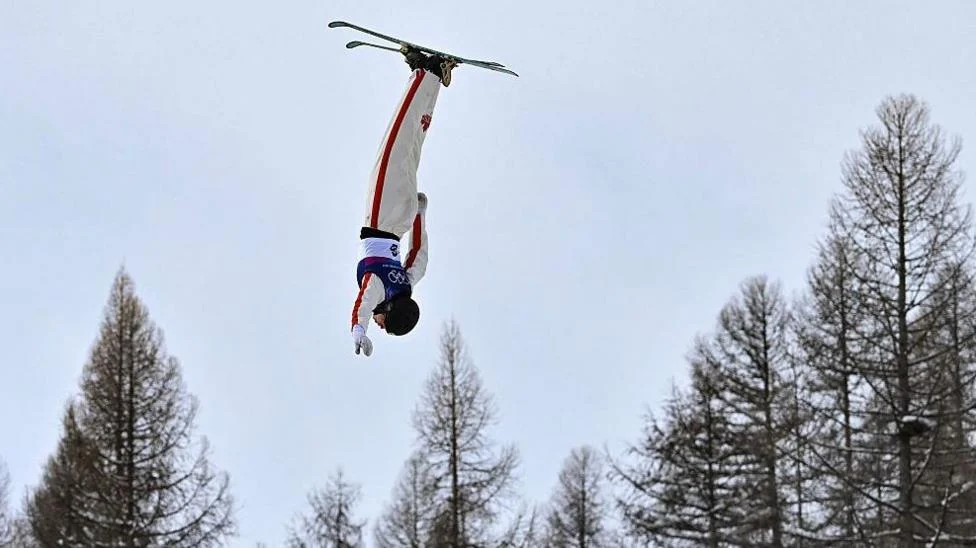
Beyond gymnastics, governing bodies across several judged sports are testing AI tools to enhance accuracy, remove subjectivity, and clarify scoring for general audiences. Winter sports organisations plan to test algorithms alongside human judges in aerials skiing, with aims to roll out the system across halfpipe, slopestyle, and big air disciplines by 2029.
International Ski Federation secretary general Urs Lehmann stated that AI could dramatically streamline operations. Current manual judging in aerials averages one minute and 45 seconds per competitor, whereas automated systems could yield scores within 15 to 20 seconds, improving broadcast pacing while eliminating spectator influence and emotional bias.
Meanwhile, the International Equestrian Federation (FEI) plans to trial AI scoring in dressage World Cup events. FEI dressage director Ronan Murphy told BBC Sport that technology could also assist in monitoring horse welfare, such as detecting improper head alignments. However, Murphy emphasized that AI cannot evaluate subjective elements like rider-horse harmony, ensuring human judges will remain essential to equestrian competition.