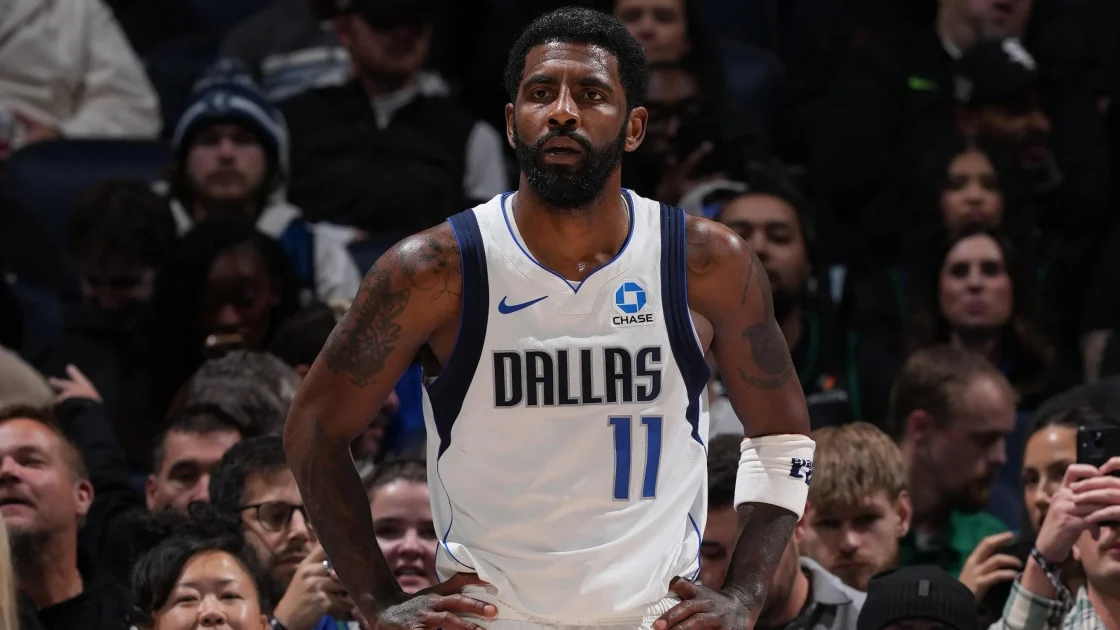
Kyrie Irving remains on the radar of opposing clubs ahead of the February trade deadline, even though the Dallas Mavericks have started the season strongly and a deal appears unlikely. According to Sam Amick of The Athletic, rival teams across the league continue to view Irving as a player who would generate massive trade interest because he stands out as a potential target capable of truly altering the playoff landscape through a trade.
Performance and Contract Situation
Concerns regarding Irving’s recovery from a torn ACL that sidelined him for the entire 2025-26 season have dissipated. In 10 starts, the 34-year-old averages 21.6 points per game while shooting 47.9 percent from the floor, including 39.0 percent from beyond the arc. The Mavericks have carefully managed his workload, limiting him to 30.1 minutes per contest, which would mark a career-low average if maintained.
Irving’s contract includes a $42.4 million player option for the upcoming season. If he maintains his health and high level of play, expectations point toward him opting out to pursue a multiyear agreement. Although his age diverges from the franchise’s rebuilding timeline around Cooper Flagg, the team possesses short-term financial flexibility due to a lack of heavy long-term salary commitments.
Team Direction and Future Outlook
Following his appointment as team president in May, Masai Ujiri has not shown any desire to trade Irving, stating before the season that the organization truly believes in the nine-time All-Star as part of the supporting cast for Cooper Flagg. The pairing has produced a 7-5 record thus far, featuring victories against the Oklahoma City Thunder and Houston Rockets, though a recent 133-94 defeat to the Minnesota Timberwolves tempered the strong start.
Flagg cannot sign an extension until the summer of 2028, and that agreement would not begin until the 2029-30 campaign, while PJ Washington is the sole Maverick holding a guaranteed salary exceeding $20 million for the 2027-28 season.
Ujiri designed the current campaign as an evaluation phase for the roster. While early results have proven positive, circumstances can shift prior to the February 11 trade deadline, and a wave of star injuries across the league could potentially prompt the Mavericks to leverage rival interest for a substantial return.