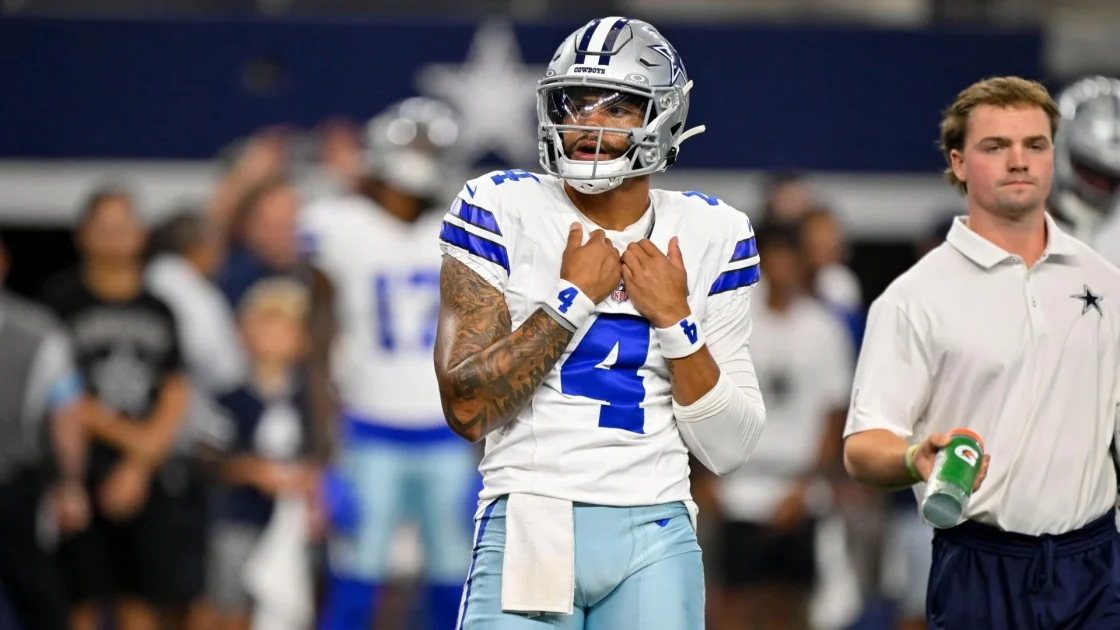
Dallas Cowboys quarterback Dak Prescott delivered a candid assessment on Thursday regarding whether the team has established a clear offensive identity through eight games this season. Speaking in Frisco, Texas, the veteran signal-caller questioned the team’s current trajectory while pledging that performance would improve moving forward.
“Is it one we’re proud of? I don’t know,” Prescott said Thursday. “We’ll be better, I can promise.”
Statistical Shifts and Scheme Adjustments
Although Dallas is averaging 27.4 points per game, the offensive system under offensive playcaller Brian Schottenheimer has become noticeably less varied and less quarterback-friendly compared to previous campaigns. The Cowboys currently rank near the bottom of the league in several key operational metrics, including pre-snap motion, play-action pass attempts, and under-center formations.
In prior playcalling setups, Dallas ranked in the top half of the NFL by utilizing play action on 28.2% of snaps, lining up under center 38.4% of the time, and employing motion at a 56.6% rate. Under Schottenheimer, those numbers have declined significantly. The Cowboys now rank second-to-last in motion rate at 36.5%, 22nd in under-center frequency at 30.4%, and 21st in play-action usage.
While the offense remains built around Prescott and a high-profile receiving corps, running game struggles have exacerbated the team’s pass-heavy approach. Dallas averages just 94.1 rushing yards per game, ranking eighth-worst in the NFL, and runs the ball at the fifth-lowest rate in the league at 32.5%.
Differing Perspectives on Pre-Snap Motion
The strategic shift highlights a tactical divergence between Schottenheimer and Prescott. Schottenheimer’s philosophy suggests that utilizing motion becomes more difficult when playing from behind and can potentially cloud the tactical picture for a quarterback prior to the snap.
Prescott, however, views pre-snap movement as a critical tool for reading opposing defenses and creating advantageous matchups on the field.
“Sometimes, it’s [motion] just to dress it up and take the defense, give them a different look of us running a core play and breaking some tendencies with a motion to get this play done,” Prescott said. “Sometimes it’s used strictly for me to see the disguise, to see the matchups that we’ve got or to create different matchups by moving them from one side to the other and really just getting all the information I can through motion.”
With the Cowboys defense continuing to allow heavy scoring, the offensive unit faces mounting pressure to resolve these tactical differences and reignite its consistency over the remainder of the season.