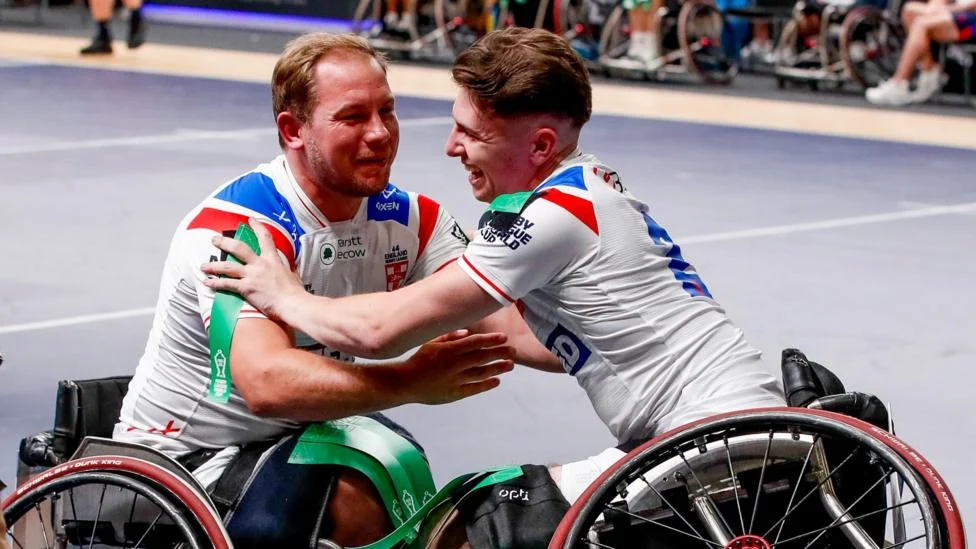
England’s wheelchair rugby league team has provided national supporters with a bright spot during the World Cup campaign in Wollongong, Australia. Following early exits by both the men’s and women’s running squads, the reigning world champions opened their title defense with a decisive 98-18 win over Wales at the Win Entertainment Centre.
England’s Title Defense and Squad Depth
England has reached the final in all five stagings of the Wheelchair Rugby League World Cup, winning titles in 2008 and on home soil four years ago. The team will aim to continue its momentum against the United States in its next Group A fixture on Tuesday.
The squad is captained by 25-year-old Rob Hawkins, who received the Wheels of Steel award as the top player in the Wheelchair Super League this year. Hawkins, who helped Halifax Panthers secure the Grand Final title, scored 11 of England’s 18 tries in the opening match against Wales.
The roster features diverse athletic backgrounds, including former Portugal basketball international Luis Domingos, who now represents Sheffield Eagles and England. Teammate Jack Brown, an able-bodied player who entered the sport alongside his brother, spent over five years coaching in Australia while working as a welder before committing fully to the sport. Brown is set to become the head coach of Wakefield’s wheelchair side next season.
The team also includes player Finlay O’Neill, who transitioned to wheelchair rugby after suffering a knee dislocation at age 16 that ended his running career. He joined Halifax Panthers three years ago.
“If you’d said to me when I was told I couldn’t play rugby league again that it’s going to be the best thing to ever happen to me, I’d have said ‘you’re lying’,” O’Neill told BBC Sport. “Discovering wheelchair rugby league, which is even better, has been a blessing.”
Rules, European Powerhouses, and World Cup Contenders
Wheelchair rugby league shares several core mechanics with the traditional 80-minute game, utilizing an oval ball where five-player teams have six tackles to score. Defensive tackles are made by detaching tags from opponents’ jerseys. Tries count for four points, while conversions and penalty goals—punched off a tee over the posts—are worth two points. On-field lineups allow a maximum of two non-disabled and three disabled players.
Unlike the running game dominated by Southern Hemisphere nations, wheelchair rugby league’s power center remains in Europe. France stands as England’s primary rival, having met them in the past three tournament finals. France took victory in 2013 and 2017 before England claimed a 28-24 win in Manchester four years ago. Third-ranked Ireland also demonstrated its strength by defeating the United States 110-10 in their opening match.
Host nation Australia presents a formidable challenge after securing a 112-14 victory over New Zealand in Group B. Australian captain Bayley McKenna, the team’s first able-bodied skipper, took up the sport in 2006 to support his father following a paralyzing accident. McKenna previously experienced online harassment regarding able-bodied participation in wheelchair sports.
“I would have copped about a dozen messages from people all around the world saying, ‘you’re a fraud, you shouldn’t even be in the chair, this is a sport for disabled people’,” McKenna told ABC. “These guys were coming at me, like, ‘you’re lucky you’re not out there on the street by yourself’.”
McKenna emphasized the persistent misunderstanding surrounding non-disabled athletes in the sport, adding, “There is such a stigma around able-bodied athletes playing in wheelchairs. It is ridiculous. I’d be lying to you if I said I was going into this World Cup not expecting it.”
Following a closely contested two-match Test series between Australia and England last year, the host country aims to compete for a full sweep across the men’s, women’s, and wheelchair World Cup tournaments taking place concurrently.