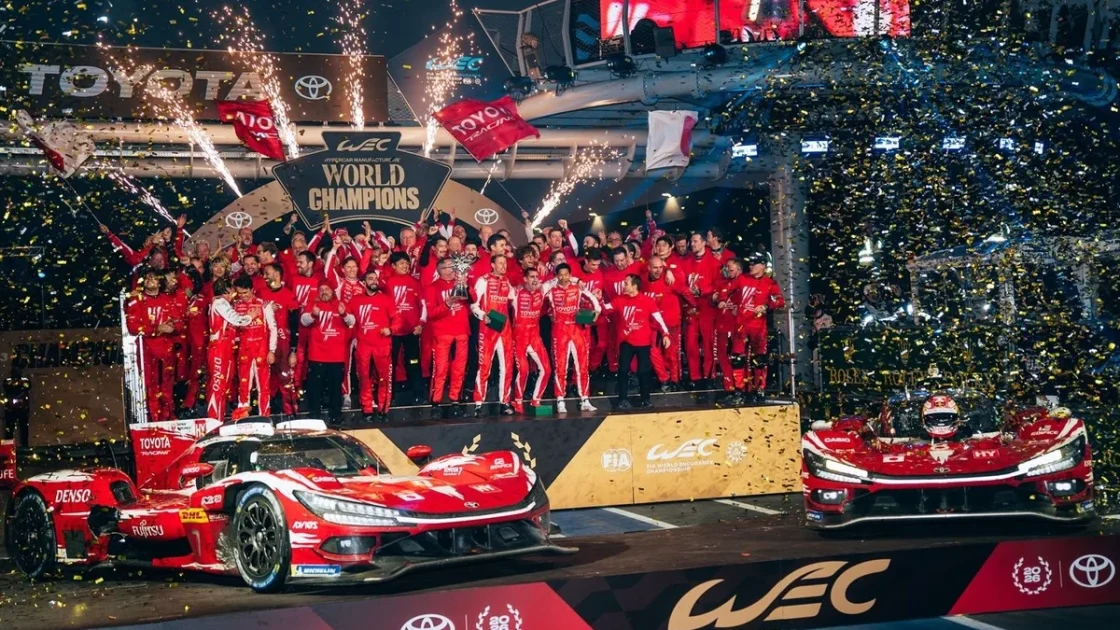
The 2026 World Endurance Championship season finale at Monza was supposed to feature a high-stakes championship battle between the two Toyota GR010 Hybrids without any team orders. Instead, the event delivered an anticlimax that highlighted the core weakness of sportscar racing’s current era, as the Balance of Performance appeared to dictate results rather than balance the cars.
A Dramatic Swing in Performance
Toyota arrived in Italy after dominating large portions of the season, but pre-event Balance of Performance adjustments seemingly pegged the engineering powerhouse back so severely that a competitive title fight became practically impossible. The #7 Toyota needed a top-two finish to secure a realistic shot at the title, yet both Toyota entries struggled significantly for pace. The car that had served as the benchmark throughout the year dropped entirely out of the points-scoring positions on raw speed alone, with the #8 car only reaching 10th place following a post-race penalty for the #007 Aston Martin. Meanwhile, rival manufacturers fought for the race victory, leaving fans without a genuine contest between the season’s two leading crews. It proved difficult to explain to the Monza spectators that a world championship was decided by two crews unable to finish in the points on merit during the finale.
Motorsport.com reported that it remains hard to understand how the exact same manufacturer package that dominated the previous round in Barcelona only three weeks earlier suddenly became the slowest Hypercar entry by a significant margin, spanning the entire spectrum from first to last between consecutive races. Comparing the situation to other motorsport categories, even NASCAR does not experience such erratic swings. While drivers in other series can salvage points on a difficult weekend, the WEC season for Toyota resembled an unpredictable yo-yo. The team ultimately secured the title despite these performance fluctuations rather than because of them.
Questions Surrounding the Balance of Performance
Toyota technical director David Floury expressed clear disappointment regarding an artificial-feeling finale, stating as reported by Motorsport.com, “It was a bit sad to come here knowing that we would not have a real chance.” He noted that the sporting contest of the title showdown was stripped away before the cars even took to the track. While Automobile Club de l’Ouest chief Pierre Fillon stated in April that the Balance of Performance accounts for only 30% of a weekend outcome, the actual impact on the results suggested a much greater influence.
This issue is amplified by strict secrecy surrounding the calculation process, leaving observers unable to differentiate between true engineering success and administrative changes. In contrast, IMSA makes its Balance of Performance data public. Discussing the system during Le Mans in June, FIA senior circuit sport director Marek Nawarecki explained to Motorsport.com, “The aim of the BoP is to ensure that all cars have a similar theoretical potential. That does not mean they will achieve the same performance on track. Factors such as strategy, set-up, driver performance, reliability, and overall execution are decisive in the end. At a race like Le Mans, experience also plays a major role. BoP controls the potential of the cars; what teams do with that potential is left to competition.”
Sportscar racing’s current golden era faces serious risks if regulators maintain excessive influence over championship outcomes. When a championship concludes by crowning a manufacturer that finishes as the slowest on the final race weekend, the underlying system faces fundamental questions.