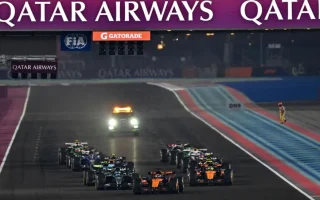

Formula 1’s recent Las Vegas Grand Prix produced a record-breaking statistic with 352 overtakes and 35 lead changes over 50 laps, breaking the championship’s all-time passing record. However, runner-up Lando Norris questioned the authenticity of those passing maneuvers from inside the cockpit.
Overtaking and Electric Boosts
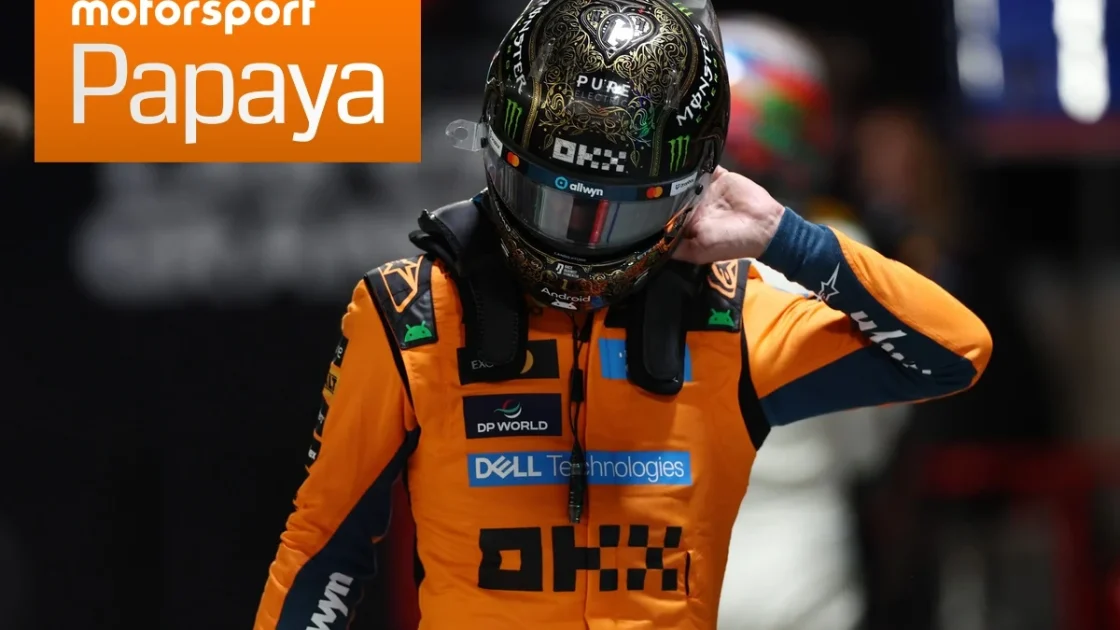
Speaking in the FIA post-race press conference after finishing 0.639 seconds behind Max Verstappen, the McLaren driver pushed back on the raw count. He argued that battery-driven speed deltas made many of the passes on the Las Vegas Strip feel less like genuine racing moves.
Norris echoed Verstappen’s earlier dismissal of the drafting battles as playing Mario Kart. “From a racing point of view, from the outside, I’m sure it probably was the best race ever in Formula 1. You never know what’s going to happen. There were overtakes out of nowhere,” Norris said.
From the driver’s seat, the experience lacked organic racing feel. “The thing is, sometimes you have a closing speed of 20, 30 kph to people, especially to us, and some of the overtakes weren’t overtakes – you press boost, and you go past someone,” Norris explained.
McLaren struggled with straight-line speed throughout the weekend. A day after calling the MCL40 horrendous on the straights—having lost nearly eight-tenths to Kimi Antonelli through Sector 3 in qualifying while carrying a stray plastic bag under his floor—the British driver dropped outside the top 10 early on while managing his electrical power deployment.
Clean driving eventually brought results, as late mistakes by George Russell on Lap 48 and Antonelli on Lap 49 secured a two-three finish for McLaren alongside Oscar Piastri, marking the team’s first double podium since the Miami Grand Prix in May.
Looking Ahead to 2030 Regulations
Despite questioning the purity of the boost-assisted passes, Norris acknowledged the positive aspects of the Las Vegas venue. He noted that cool desert asphalt prevented tire overheating in dirty air, which would keep wheel-to-wheel battles intense without requiring constant electrical reserve management.
“We would enjoy it even more as drivers because we’d be able to push and go flat out and not have to think about re-gen and battery and not deploying and deploying and all of this stuff,” Norris said. “So yeah, we could have been even better is what I’m trying to say. So imagine in 2030 – oh my God, that’s going to be the best race you’ve ever seen.”
Norris’s outlook follows a breakthrough in Nevada, where the FIA announced a unanimous agreement in principle for a lighter 2030 ruleset focusing on simpler 2.1-litre turbocharged V8 engines, sustainable fuels, and reduced hybrid complexity, pending a World Motor Sport Council vote in Shanghai next month.
Following his recent podium finishes, Norris is tied with Russell on 264 points—three behind Lewis Hamilton in third place—while Red Bull’s constructors’ lead over McLaren has narrowed from 17 points to nine, with 440 to 431 points, as the season heads to Qatar and Abu Dhabi.