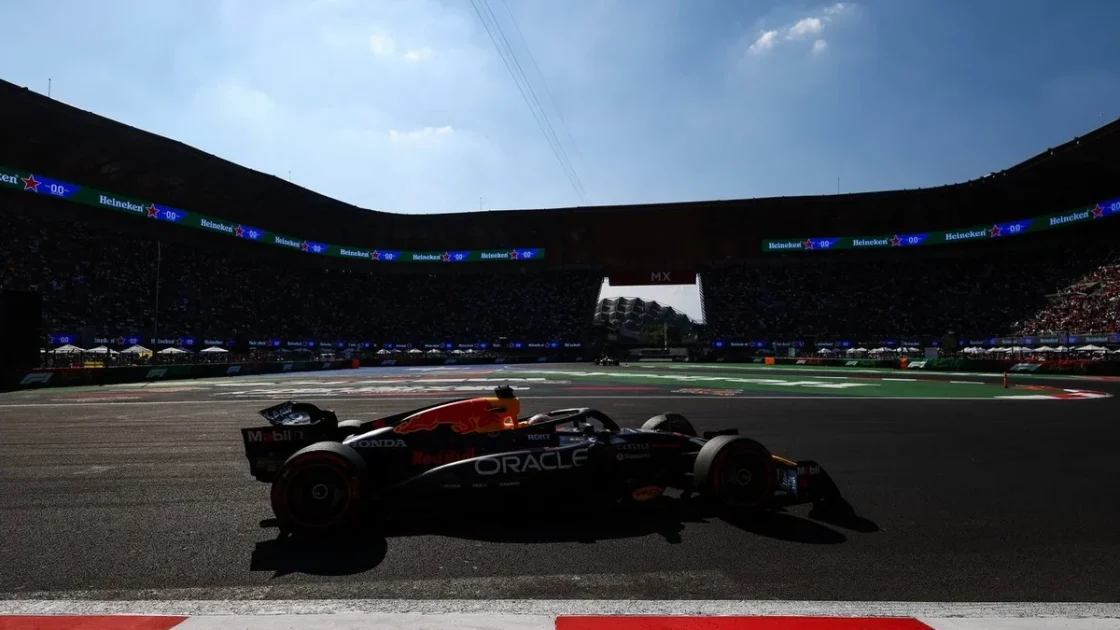
Sitting 2,286 metres above sea level, the Autodromo Hermanos Rodriguez is the highest-altitude venue on the Formula 1 calendar. The resulting thin air creates a unique challenge for teams and manufacturers, who face more unknowns this weekend than ever before.
Power Unit Strains and Turbo Challenges
The lower air density places considerable strain on the power unit and particularly the turbo, which must work much harder to push the same volume of oxygen into the engine compared to sea level. To achieve the required boost pressure and airflow, the turbo has to spin significantly faster, operating at much higher temperatures and affecting both performance and reliability.
This dynamic led George Russell to point to Ferrari as the weekend favourite during the Thursday press conference, as the Scuderia is known in the paddock for running a smaller turbo than many rivals. A smaller turbine wheel possesses less mass and inertia, which allows the turbo to spool up much quicker after throttle application and minimize turbo lag.
Minimizing lag is crucial this year because the MGU-H has been removed and can no longer assist in counteracting turbo lag.
“Last year, we had the MGU-H, so we had some support from MGU-H, but this year we don’t have the MGU-H anymore, so that makes it quite challenging,” Honda’s chief engineer Shintaro Orihara told Autosport. “For example, even just in idle conditions, we had MGU-H support to get enough boost pressure, but this year we don’t have any support even in idle conditions. That is a big difference from last year and therefore turbo lag is the most interesting and important topic at this track. I think that is not only the case for Honda, but for all manufacturers. They will all struggle with turbo lag at this track.”
If manufacturers fail to achieve the desired turbo boost, Honda warned that it could force restrictions on how the internal combustion engine is operated, potentially leading to a lower power output in the worst-case scenario. Orihara explained that every turbocharger has operational speed limitations, and if the maximum speed is reached without providing enough boost, the engine’s operation point will be restricted. While dyno testing suggests little to no impact, Honda noted that these conditions must be verified during free practice.
The situation represents a critical test for Honda, which previously struggled with turbo lag in Singapore despite introducing a new turbocharger in Madrid. Although countermeasures introduced in Austin proved positive and work continues in Sakura on strategies involving the MGU-K, Orihara emphasized that altitude changes everything and makes free practice essential for understanding car behavior.
Active Aerodynamics and Grip Concerns
The absence of the MGU-H is not the only regulatory change impacting the weekend, as active aerodynamics also alter how teams approach wing selections. Teams traditionally opt for Monaco-level wing setups in Mexico to benefit from lower air resistance, though these extreme choices still only yield Monza-spec downforce levels due to the altitude.
Max Verstappen explained that active aerodynamics have removed much of that traditional wing variation. Verstappen noted that the cars have less grip and that teams are essentially forced to run a single wing to compensate for the altitude.
Combined with the already reduced downforce of 2026 cars compared to previous ground-effect generations, Isack Hadjar predicted the track conditions will feel “slippery as hell” for drivers.
New asphalt on the circuit could theoretically provide better grip, though it represents another variable simulations have not fully accounted for, according to Aston Martin’s chief trackside officer Mike Krack. Krack pointed out that the loss of 20 to 25 percent in air density translates to an equivalent loss in load, meaning any gains from tyre-road interaction will be vital, alongside monitoring how much the dirty track cleans up during the opening session.
These combined factors on both the power unit and chassis sides mean competitors enter the Mexican Grand Prix weekend facing more questions than ever.