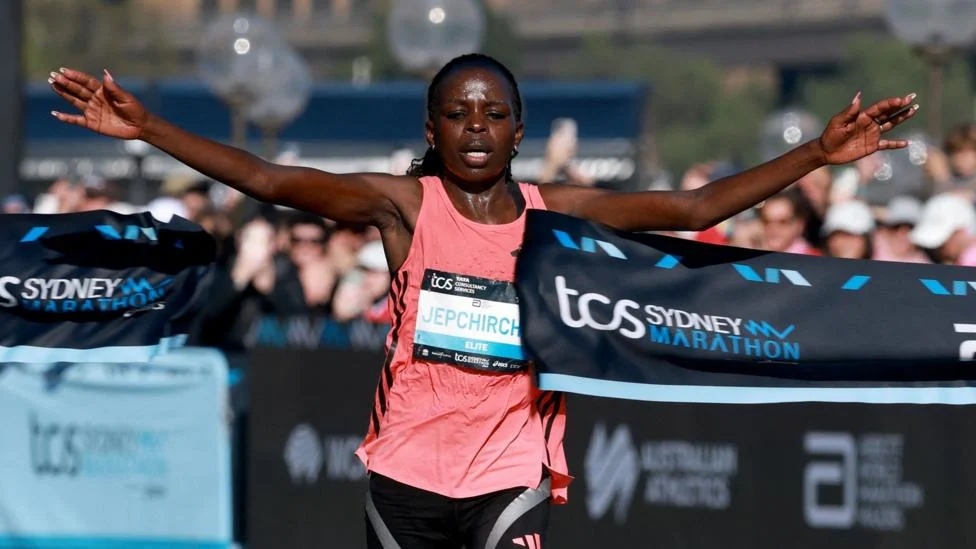
Reigning world marathon champion Peres Jepchirchir has been banned for three years for a doping violation. The 33-year-old athlete, who claimed Olympic gold in 2021, received a provisional suspension from the Athletics Integrity Unit (AIU) in October following an out-of-competition sample that tested positive for erythropoietin (EPO).
Details of the Sanction and Other Cases
The sample was collected within Kenya prior to Jepchirchir’s victory at the Sydney Marathon on August 30, 2026, and returned an adverse finding on September 17. EPO is a natural kidney-produced substance stimulating new red blood cells, which can be injected to enhance oxygen delivery to muscles. While Jepchirchir denied using EPO, she signed an admission of violations form and accepted the disqualification of all competitive results achieved since July 17, 2026.
Jepchirchir joins two other high-profile Kenyan athletes facing sanctions. Veronica Loleo received a three-year ban after admitting to EPO use, while Ronald Korir was handed a six-year ban for failing to explain biological passport abnormalities. Jepchirchir’s illustrious career also features major victories at the New York Marathon in 2021, the Boston Marathon in 2022, and the London Marathon in 2024.
Wider Scrutiny on Kenyan Athletics
Brett Clothier, chief executive of the AIU, noted that Kenyan authorities have advanced in combating doping over the past five years, though these cases show significant work remains. The Kenyan government is aware of the situation, committed to strengthening the Anti-Doping Agency of Kenya, and aims to target criminal networks facilitating doping. The AIU plans to discuss these commitments with the government in upcoming months.
In September, Kenya secured the rights to host the 2029 World Athletics Championships over London and Rome, intensifying scrutiny on its long-running doping challenges. Since 2017, the AIU has suspended more than 140 Kenyan athletes, predominantly distance runners. Wada president Witold Banka told BBC Sport last month that Kenya must demonstrate its status as a clean home of athletics to preserve credibility before the 2029 event.
This suspension follows the sanction of 2019 world champion Ruth Chepngetich last year, marking the second high-profile Kenyan doping case in two years. Although the AIU has stated that the country’s cases are isolated without systemic violations, and local officials point to stronger testing, persistent elite cases continue to test the sport’s integrity. Parliament currently has a proposed anti-doping bill, and effective implementation alongside broader enforcement will be vital as Kenya prepares to host the major global championships.