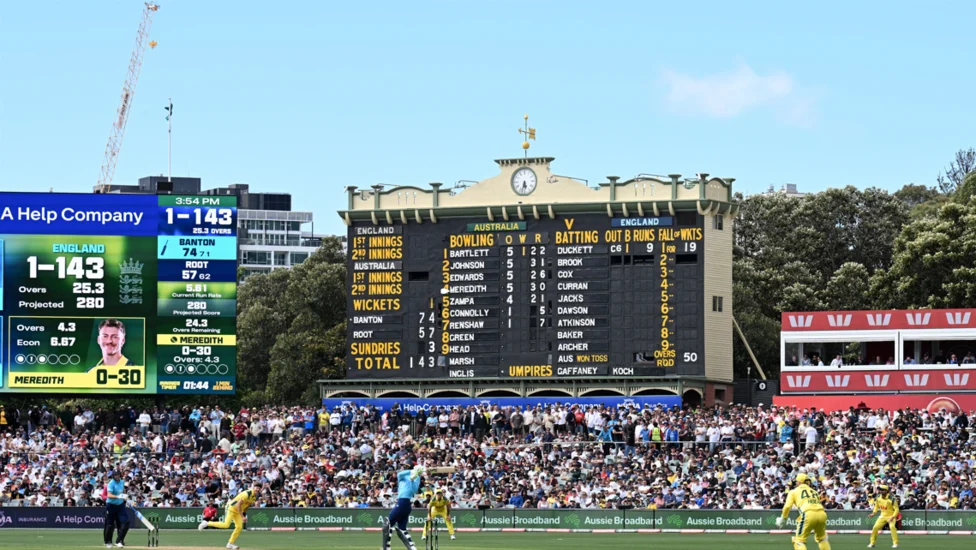
In Australian cricket venues and television broadcasts, match scores are displayed in reverse compared to England and the majority of other cricketing nations. While a total of 200 runs for the loss of four wickets is typically written as 200-4, Australian broadcasts and stadiums present the identical score as 4-200.
The origin of Australia’s scoreboards
This distinct ordering stems from a 19th-century tradition created by former Australian cricketer Ned Gregory. After becoming the curator of the Sydney Cricket Ground, Gregory found the traditional English scoreboard design inadequate because it failed to provide spectators with sufficient match details.
To fix this, he built a massive scoreboard featuring comprehensive match information that required a minimum of two operators to run. A key feature of his redesign placed the number of wickets taken before the total runs scored. His scoreboard concept gained immense popularity in Sydney, prompting other stadiums across Australia to adopt the layout. The format eventually became standard practice across Australian stadiums and broadcasting, persisting to the present day.
Ned Gregory’s Test cricket history
Before designing his famous scoreboard, Gregory achieved a notable piece of Test cricket history as a player. He represented Australia in the inaugural Test match against England, held in Melbourne during March 1877. When Australia took the first innings, Gregory was dismissed without scoring, earning the distinction of being the first Test batter in history to be out for a duck.