
Table of Content
England fly-half Fin Smith is proving that physical ball-carrying is not just for the forwards, using his willingness to take on defences to add an unpredictable dimension to his team’s attack.
A Standout Ball-Carrier in the Backline
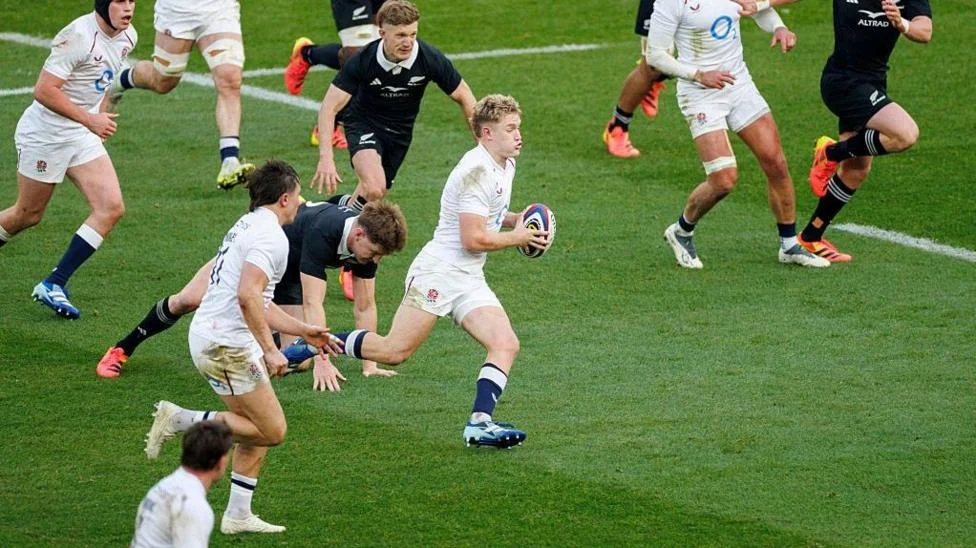
Speaking to BBC Sport, Smith jokingly described teammate Ben Earl as “greedy” after the number eight carried 32 times in a 37-12 victory over New Zealand. While Earl dominated the statistics, Smith also made a major impact by carrying the ball 11 times against the All Blacks, registering the third-highest total of any England player.
That tally is even more remarkable considering the fly-half achieved it in just 55 minutes on the pitch before cramp forced him off. Standing at 5ft 10in and weighing less than 14 stone, the Northampton player frequently takes on heavy defensive traffic, having carried nine times against Australia a fortnight prior.
According to statistics from Oval Insights, Smith has carried the ball more than any other fly-half in a Six Nations side this year. When including Rugby Championship teams, only three fly-halves in the world—New Zealand’s Richie Mo’unga, South Africa’s Sacha Feinberg-Mngomezulu, and Argentina’s Tomas Albornoz—have backed themselves more with the ball in hand.
Embracing Physicality and Interchangeable Roles
Smith acknowledges he lacks the sheer athletic size of some of his global rivals, but he believes his commitment to playing through the defence rather than in front of it helps orchestrate a more effective attack. He stated that avoiding physical contact goes against his character, noting he would hate to ask teammates to put their bodies on the line if he were unwilling to do so himself.
With players like George Furbank, Henry Slade, and Seb Atkinson capable of stepping in at first receiver, England can afford to have Smith tied up at the breakdown for a phase or two. Smith explained that the modern attacking style employed by Northampton and England requires players to be completely interchangeable.
“If the right thing to do is carry or the right thing to do is hit the breakdown then so be it, and then someone else can drop in as the first playmaker,” Smith said to BBC Sport, adding that this fluidity makes the team significantly harder to defend against.
Building Momentum in the Nations Championship
Following a difficult Six Nations campaign, England have rediscovered their attacking form in the Nations Championship, scoring 44 tries across their six tournament matches—10 more than any other side. On Saturday, they face New Zealand once again in the third-place play-off during the tournament’s finals weekend at Allianz Stadium, Twickenham.
Smith noted that the team’s current winning streak, which followed a run of five consecutive defeats, stems from a more inwardly focused mindset developed after a heavy defeat to South Africa in July and a painful loss to Italy in Rome during the Six Nations. After the New Zealand fixture concludes their autumn schedule, England will turn their attention to the Six Nations, beginning with an away fixture against Ireland on 5 February followed by a match against France.