Table of Content
As the NFL reaches Week 11 of the 2026 season, the performance of the NFC South has reignited debate over the league’s playoff structure. With the 4-5 Carolina Panthers currently leading the division, the conference faces the possibility of a sub-.500 division winner for the second consecutive year and the third time in five seasons.
The Disparity and Potential Schedule Changes
Three NFC West teams and all four NFC North squads currently sit above .500, meaning 6-4 teams like the Seahawks and Rams would miss the postseason if it started this week. This ongoing discrepancy has placed renewed scrutiny on the eight-division playoff format that has remained relatively unchanged since 2002. During the first 20 years under this format, only three teams won a division with a losing record, but that frequency has risen since the league moved to a 17-game schedule in 2021.
A source with knowledge of league playoff proposal debates told sports.yahoo.com that adding regular-season games widens the separation in the standings. With the league aiming to add an 18th regular-season game in the next collective bargaining agreement, subject to NFLPA approval, that disparity could widen further.
Yahoo Sports surveyed high-ranking league sources to evaluate recent annual meeting debates and potential triggers for change. A high-ranking NFC executive who supports revamping the structure expressed doubt that any alterations will occur within the next five to 10 years, even if the schedule expands. As the executive told sports.yahoo.com, changing the system would likely require an extreme scenario, such as a seven-win team winning the NFC South while a 12-win team misses out, coupled with an influential owner representing the snubbed team. When asked if the league would ever eliminate divisions to seed solely by record, the executive noted that the appetite for that change is zero.
Arguments for Maintaining the Status Quo
Proponents of the current playoff format emphasize the importance of divisional excellence and balanced scheduling. Fourteen of a team’s 17 regular-season matchups replicate those of their division rivals, which largely eliminates the strength-of-schedule variance seen across different divisions. A second high-ranking NFC executive told sports.yahoo.com that strength of schedule reliably predicts team quality, noting that surprise teams usually benefit from a weak schedule. A high-ranking AFC executive added that the current format provides identical opportunities for every group of four teams.
Emotionally, granting top-four seeds and home playoff games to division winners heightens the significance of intradivisional games, fueling intense rivalries driven by geographic proximity. The first NFC executive told sports.yahoo.com that this dynamic benefits fandom, the game, and television broadcasts.
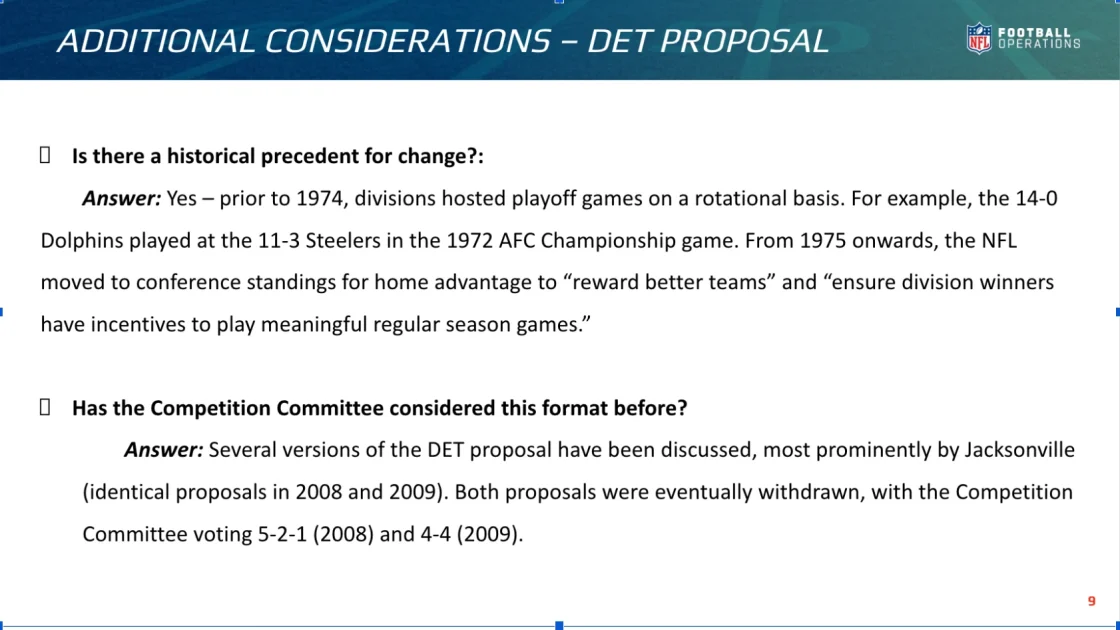
These debates have frequently appeared at NFL annual meetings, including proposals withdrawn in 2008 and 2009, as well as submissions in 2023 and 2025. In 2023, the Chargers proposed seeding wild-card teams above division winners if the champion finished below .500 and had at least four fewer wins than the wild-card team. In 2025, the Lions proposed seeding wild-card teams higher whenever they finished with superior records. Neither proposal suggested stripping division winners of playoff spots, but both questioned whether struggling champions deserved automatic home games. Both proposals failed to gain enough support.
Sources noted that complex formulas comparing win totals between division winners and wild-card teams could confuse fans and complicate playoff projections. Furthermore, determining a fair threshold remains controversial, as historical anomalies like Tom Brady’s success with the New England Patriots in a weak AFC East demonstrate that teams cannot control the strength of their division.
The Impact of a Potential 18th Game
During discussions surrounding the Lions’ proposal in 2025, a presentation outlined several advantages to altering the format, including a more competitive regular-season finish, improved TV ratings, a more equitable postseason, and a higher likelihood of the conference’s two best teams meeting in the conference championship. The primary drawback identified was a diminished incentive to win the division.
As the schedule expands toward 18 games, playoff spots could be clinched weeks in advance. Because regular-season finales currently feature divisional matchups, lopsided divisions often result in games where teams have nothing to gain, prompting coaches to rest starters. A league source present for the playoff discussions told sports.yahoo.com that adding an 18th game introduces consequences that may require new incentives for playoff qualification or draft positioning.
Addressing these issues could coincide with formulating a potential 18th game schedule. With 12 non-divisional opponents, teams could theoretically play all three other divisions in their conference, though an NFC executive told sports.yahoo.com that such a move would conflict with the NFL’s parity goals, which rely on struggling teams playing weaker opponents to ensure new playoff contenders emerge annually.
The league expanded the playoff bracket from 12 to 14 teams in 2020. For now, attention turns to the NFC South and NFC East to observe how poorly the lowest-ranked playoff teams will finish this season, while broader conversations about structural reform continue to simmer at a deliberate pace.